Sunday, August 24, 2014

Life Itself: A look at the life of the unbroken legend Roger Ebert.


Movie Review: Life Itself

Director: Steve James

Reviewed: 16 August 2014

jamesintexas rating--****


Roger Ebert would not have approved of me waiting over two weeks to write this movie review.

I meant to see his film in Houston on the big screen, possibly with some of the middle school students from Denver Harbor who met him with me in June of 2004 (impossibly, those same students are now in their twenties: some in college, and some with families). However, it seemed right to watch it in Elmhurst, a suburb of Chicago, where I grew up as a kid, although the experiencing of seeing a new movie on the television is still one I have to get used to. My parents were there on the couches and chairs next to me, and my wife who also met Roger Ebert on that trip over ten years ago was at my side. The spirit of family, community, and place swirled about me most fittingly as I watched Steve James's new documentary Life Itself, among the very people who would purchase the Sunday Chicago Sun-Times on Saturday to start going through it the night before. That Sunday Sun-Times featured essays and interviews conducted by Roger Ebert and in late December every year, it featured his best movies of the year. Those lists and his myriad books dominated my consciousness and still do, beckoning me to try new directors, genres, and expand my canon. I have no doubt that Roger Ebert helped steer my parents towards films such as Glory, Goodfellas, and The Crying Game during 1991-1993, and they mentored me by showing me my first real works of cinematic art at a formative time in my life. My Friday morning ritual in high school was to run the two mile loop up Myrtle Ave to the train tracks, train tracks down to York Road, stop somewhere downtown with my 85 cents in hand to purchase a Friday Tribune and a Friday Sun-Times for Siskel and Ebert's written movie reviews, and then jog back home with the papers in hand, usually passing Nu-Time Video with an alluring movie poster beckoning from beside the front door. I would read the movie reviews first--before sports, the front page, and any sort of world news. They were that important to me. Ebert's writing was voluminous and profound: lengthy treatises with literary analysis, rich in film history, but always written with his unique and approachable voice. His television persona to me was not as strong, but I saw Siskel & Ebert whenever I could, and I always found it to be illuminating. Two smart guys on television talking about movies! And not always agreeing! About two weeks after graduating college, I met Ebert at the Harold Washington Library where he read e.e. cummings's poetry aloud and signed a copy of his book to me. Later that first year as a teacher, Ebert emailed back and forth with me about teaching the very course at that Houston school that would lead me to being able to meet him three years later. He was a champion of film and of life, and Steve James expertly captures that in this film, the best of the year so far.

Clearly, as a Roger Ebert fan, Steve James's film worked for me on multiple levels, but as I watched James unfold the debilitating and devastating medical diagnoses that Ebert receives and lives with as does his wife Chaz juxtaposed against the wilder, raucous years of the Pulitzer Prize winning writer's life, I found the core of the film through the title. Life itself. Roger Ebert was so much more than just an attitude or a persona. His life itself was about finding what defined his life, and the search for truth never goes simply or smoothly. Ebert has described movies as being "empathy machines" because of their transformative and evocative power to take us inside worlds in surprising ways. Movies connect and allow us to, as Atticus Finch would say, "put yourself in someone else's shoes and walk around for a little bit," to paraphrase the familiar line. We walk in Ebert's shoes in this film as James skillfully weaves from his childhood and rise to prominence as a critic as well as a television personality, and then again, we walk with him through painful years of alcoholism and in physical therapy as a battered but unbroken Ebert fights to regain control of his body. We walk with Chaz, the love of his life, and the woman whose life for Ebert defines the film and him. His success, James makes me think, would have been merely empty laurels without the love of Chaz and the joy he felt when with her and their family together. Home video clips punctuate this feeling.

I knew I would love the old Siskel & Ebert clips and out takes, some particularly vicious and petulant. I knew the talking heads aspects of the film would work for me, hearing tales of old Chicago and old newspaper business. The film shows an imperfect man adrift in a successful life who found love, and that love anchored him in a way nothing else ever could. Instead of canonizing or lionizing the beloved Ebert, James aims at presenting a more balanced, more honest portrait. Friend Martin Scorsese discusses their friendship and the pain of a negative review for The Color of Money. Gene Siskel's widow recounts their bickering, professional jealousy, and at times, awfulness to each other. Chaz shows the grace and grief of a partner turned caretaker when the simple act of walking up the stairs can become a trying ordeal of shaken heads, upset hands, and even rage. Throughout it all, James's focus on Ebert analyzing his life and considering his own mortality allows us a shockingly intimate and hopeful picture of what it means to live and what it means to die.

Steve James was brought onto my radar by Roger Ebert in 1994 with the documentary Hoop Dreams, and Ebert's championing of that film brought it worldwide renown and an Oscar nomination for Best Editing (though none, criminally, for Best Documentary). James has continued to make fascinating films ever since, from Stevie to The Interrupters, and what a uniquely appropriate joy it would be in late February to see Steve James standing at the Academy Awards accepting an Oscar, finally, for this tribute and examination of the great Roger Ebert. To me, Life Itself, like Ebert's autobiography of the same name that provides some of the film's foundation and shape, allows an audience to ponder the deepest questions of what makes our lives worth living while retaining the joy and twinkle of the man who would have written this review much more eloquently and much more rapidly.


Sunday, July 27, 2014

Innovative Documentary: The Unforgettable Cutie and The Boxer

Movie Review: Cutie and The Boxer

Director: Zach Heinzerling

Reviewed: 26 July 2014

jamesintexas rating--***1/2


Zach Heinzerling's innovative documentary Cutie and The Boxer starts out as a chronicling of the life of aged artist Ushio Shinohara, an artist know for dipping boxing gloves with sponges into paint and punching his way across a campus. However, Heinzerling subtly shifts gears and focuses in just as much on Ushio's wife Noriko, herself an artist who has had to put her career on hold to support her husband and raise their son. Set in their ramshackle but intensely beautiful apartment in New York City, the film explores the nature of artistry and what it means to support an artist. Noriko's drawings of heroine Cutie have never been revealed to an audience like her more well-known husband's paintings and sculptures. Noriko's self-definition and stepping out into the light require a recalibration of their relationship at this very late age, making for fascinating cinema.

Heinzerling captures the astonishing intimacy of the creation of the artwork, the packaging and marketing of a gallery show, as well as using animation to take us inside Noriko's drawings. The couple's shared history is documented through home movies and archival footage of them as a younger couple. I would be astonished to know if Heinzerling knew where this story would go. Cutie and The Boxer exists as a singular and unique portrait of an artistic couple growing and healing, moving forward while struggling as artists. There are many moments of unspoken pain with echo through their respective art.

The final shot achieves a quiet perfect beauty of equilibrium. I highly recommend this film.


No Country For Old Counselors: Ridley Scott's The Counselor

Movie Review: The Counselor

Director: Ridley Scott

Reviewed: 17 July 2014

jamesintexas rating--***1/2


Cormac McCarthy is one of my favorite authors of all-time, and The Counselor pairs his first ever screenplay with the visual flair of director Ridley Scott. The result is a surprisingly haunting series of philosophical conversations between two characters punctuated by scenes of grotesque and intense violence all set against the backdrop of the modern day border between Mexico and the United States. If 1980 was the time of No Country For Old Men and Tommy Lee Jones's sheriff Ed Tom Bell realizing his impotence in the face of the growing border violence, The Counselor is its contemporary aftermath, its promise of reckoning in a world where the cartel wields unspeakable, nearly mythical power. We are left watching the criminals squabble and scurry against each other, and one wrong decision can led to the abyss.

The Counselor (Michael Fassbender) loves his fiancee Laura (Penelope Cruz), jets to Europe to buy her a diamond engagement ring, swims in the world of criminals as their lawyer, but when he finally chooses to get into the drug trafficking business with club owner Reiner (Javier Bardem), things fall apart. A drug courier goes missing; a jailed mother asks for a favor; something ferocious is set in motion that cannot be stopped. The center cannot hold. Reiner and girlfriend Malkina (Cameron Diaz) are the kinds of people who sit on blankets in the desert watching their pet cheetahs attack jackrabbits. Westray (Brad Pitt), himself a shady businessman offers his own counsel about crossing the threshold with these forces. The Counselor finds himself in over his head in every possible way.

With its talky, philosophical structure and multiple reveals, The Counselor may best reward a second viewing because it takes until the final scene to understand all that has come before. I was interested in its red and purples, its liminal states between day and night along border roads, its gallows humor regarding a cartel shipment, and its deep conversations, particularly one with the mysterious god-like Jefe (Ruben Blades) who tells the Counselor enigmatically, "You are the world that you have created." The conversation seems a natural extension of ones held by Anton Chigurh in No Country For Old Men. "Call it," Chigurh would have said, but the Counselor's choices have imprisoned him far beyond the reach of any form of chance or hope.

The Counselor is a brutally harsh film with a performance from Fassbender that conveys terror but also distance. There is a scientific, almost clinical dispatching of characters and violence as we watch pieces swept from the chessboard with expediency. "Mere anarchy is loosed upon the world / The blood-dimmed tide is loosed" as the Yeats states in his poem "The Second Coming," and no one can hold the floodgates back. I found its ending astonishing, as well as the multiple meanings of the title. Whose counsel does one trust?


Don't Purge Everything: There's Something Powerful Here

Movie Review: The Purge

Director: James DeMonaco

Reviewed: 24 July 2014

jamesintexas rating--**


The Purge's premise is that in the near future, the United States will be reborn and its new founders rise to power by allowing the populace a twelve hour purging of violence and hatred every year. In a sort of bizarre twist on Shirley Jackson's short story "The Lottery," neighbor can turn against neighbor, rich against poor, family against itself, all against the legal and permissible backdrop of the government's system. According to experts, the idea of the purge makes society more safe and controllable. "Would you kill someone tonight, dad, if you wanted to?" asks the wide-eyed preteen son of Mr. and Mrs. Sandin (Ethan Hawke and Lena Headey). "Yes," the father replies, "but we don't feel the need to do so." Instead, the well-to-do Sandins, flush with the nicest house and most advanced security system in the neighborhood, hunker down with their myriad cameras, content to watch the rest of the world on this one night of lawlessness, revenge, and chaos. Of course, the chaos arrives at their front door, and when the youngest Sandin, Charlie (Max Burkholder) opens their security system to save a homeless man being hunted, the hunters find themselves standing at the gate, knocking to be let in, wearing creepy masks. And daughter Zoey (Adelaide Kane) may have let more in quite unknowingly as well.

The premise is better to think about than to watch in execution. Playing off our post 9-11 fears, The Purge could have reached for more resonance with our modern era, but instead it is content to degenerate into a home invasion chase movie with jump-out scares and a completely nonsensical geography. It made me think of home effectively some movies with a confined space establish their sense of geography like, say, David Fincher's Panic Room. Here, there are conveniently places to run for fleeing family members at all times, and characters always pop out at the right time. It takes place within a gated community among members of a certain class. The opening shots hint at what happens in urban centers and play with the idea of purging being a way to regulate society, to eliminate the poor, to maintain an equilibrium. I wish the film had the courage to explore those convictions or even consider violence such as war; to see The Purge through a post-Iraq and Afghanistan lens where many of our soldiers are inordinately members of the lower classes sent into danger by those safely ensconced in power would be a potentially explosive reading. There are already elements of "The Most Dangerous Game" where man hunts man. But, the film is more content to show Ethan Hawke and Lena Headey roaming around their home with shiny, photogenic weaponry. Alas. And the director fails to convey Hawke's character's change of heart with any sort of clarity. The story needs him to change directions, so he does. That's it.

I'm not saying it is not scary. To watch it in a dark house with the shade on the front window blowing in the breeze and casting weird shadows over everything, with noises amplified tenfold in the night, and with a consciousness of I'd better not scream and wake up my sleeping nine-month old, The Purge has its moments. But I would not recommend it or want to watch any part of it again; there really is not much going on under its mask, unfortunately.


Far From Heaven: A Technical Triumph

Movie Review: Far From Heaven

Director: Todd Haynes

Reviewed: 17 July 2014

jamesintexas rating--***


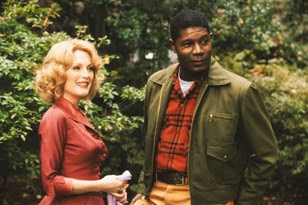
I admired Todd Haynes's 2002 film Far From Heaven, but I did not love it. Perhaps I do not know the Douglas Sirk films that he is so astutely paying homage to, but I know the type. He seeks to rip the facade off of the perfect life of the 1950's and examine sexuality, power, agency and conformity. His artistry is admirable, and Haynes has proven himself to be a master at modulating costumes and colors. Julianne Moore looks like the quintessential mother figure from any movie or television show of the era that I have seen. She plays Cathy Whitaker, the perfect mother and wife, whose life quickly begins to disintegrate around her. Within the context of the story, Cathy is trapped. Her husband Frank (Dennis Quaid) feels compelled to have a double-life and get away with it, and inside of her large home with her two children, Cathy feels heartbreakingly alone. Her growing connection with her African-American gardener Raymond Deagan (Dennis Haysbert) has a light but transgressive quality that sends waves across their idyllic Connecticut community. The more I thought about Far From Heaven, the more I thought about Ibsen's A Doll's House with its images of imprisonment and desire for female empowerment. Haynes throws conflict at these characters, but his story moves within the limitations of the time period. A climactic moment must just be that: a moment of recognition and possibility, but within the world of these characters, nothing more can be. I found the ending somewhat frustrating, but perhaps that is Haynes's point. Cathy Whitaker found herself constrained on all sides within her marriage, her social status, and her community. To break free may be what a modern audience expects.

The cast is excellent, and Moore delivers a strong performance of great interiority amidst the posturing and conventions that must be upheld as a housewife of this time period. Her best moments come when her character finds herself face-to-face with uncertainty. Quaid and Haysbert do fine work as well, and the film has a stagy quality with its small but focused cast. The bright colors of the transforming leaves hint at Haynes's message that transformation for this society is coming soon; the seasons are a changing, but the change does not come quick enough, and there are many hurt and excluded and powerless in this type of society. We see Cathy nudging ahead, uncertainly pushing forward on beliefs about race and gender that will eventually sow the seeds of the Civil Rights and Gay Rights movements to come. One cannot help but wonder what happens to her after that final shot. Todd Haynes remains a director with an eye for composing a shot, handling color and light with ease, and Far From Heaven, though perhaps less powerful for me because of my ignorance of its references and genre, has a well-crafted and thoughtful atmosphere.


Heathers: High School as Hell Stands the Test of Time

Movie Review: Heathers

Director: Michael Lehmann

Reviewed: 26 July 2014

jamesintexas rating--***1/2


Wow. Heathers, the dark high school comedy from 1988, still packs a potent punch over twenty-six years later with its quotable and memorable dialogue, memorable lead performance by Winona Ryder, and its uniquely sardonic vision. Its characters quibble about how much time they get off from school in the wake of an apparent suicide outbreak, and it all stems from the in-crowd of the three Heathers who rule the school as the original mean girls. Ryder stars as Veronica, the hanger-on of the Heathers who ends up plotting their fall from power and total destruction with the new kid in school J.D. (Christian Slater). The film concerns the power of high school cliques, the hilarious apathy of the adults in charge, and the opportunity to skewer teen culture. Although I feel that the film's second half unravels a bit and loses the momentum firmly established from the opening sequence, Heathers has a unique and often hilarious perspective on hypocrisy and facades. It is good to be reminded of a time when Winona Ryder ruled the world, and Christian Slater's performance has its own charm. At its best moments, Heathers has a kind of comic frenzy: Veronica writing in exaggerated handwriting in her diary; witty repartee between Veronica and her parents; dark monologues delivered along side coffins; an inverted conversation between J.D. and his dad; and, at last, underlining meaningful passages in Moby-Dick. Does it deserve its place among the best high school films of all time? I say because of its weirdness and wonderful script, Heathers earns a spot among the most memorable of that list. At the time, I cannot even imagine how its controversial subject matter was received; it still has a sharp edge.


Saturday, July 26, 2014

Slow Burn: Praise for Out of the Furnace

Movie Review: Out of the Furnace

Director: Scott Cooper

Reviewed: 26 July 2014

jamesintexas rating--***1/2


Out of the Furnace, the new film from director Scott Cooper, has an admirable amount of restraint in its economical storytelling, graceful concision with images that call to mind director Terence Malick, as well as real stakes for its hardscrabble characters set amidst a heartbreakingly beautiful dying steel mill town in western Pennsylvania calling to mind The Deer Hunter. A film unafraid to challenge its audience by defying conventions of the genre, Out of the Furnace features a superb cast led by Christian Bale and Casey Affleck as brothers Russell and Rodney Baze: the former, a steadfast mill worker, and the later, a haunted U.S. Army veteran of four tours in Iraq. They care for their dying father alongside their uncle Red (Sam Shepard, and after a few twists and turns, both end up in situations far beyond their control. Rodney pressures bar owner and loan shark John Petty (Willem Dafoe) to support him in fighting for money, leading him to the dark unpredictable character of Harlan DeGroat (Woody Harrelson), a menacing character first introduced memorably at a drive-in before a series of brutally violent acts. Harlan controls drugs and more in Ramapo, New Jersey, a sort of backwoods mafia network out of the television show Justified, and when Rodney goes missing, it is up to Russell to find him when traditional forces cannot.

I cannot speak highly enough about this cast. Shepard, Dafoe, Harrelson, and Forest Whitaker all shine in their supporting roles, as does Zoe Saldana in a role usually cast aside without much thought, but here, she serves plays an integral part of Russell's life. Woody Harrelson's performance is hypnotic with the capacity for violence at any time. The furnace of the steel mill anchors the film with its shimmering smokestacks, and ruined, weathered homes and mills exist as the backdrop for Russell's struggle. Bale can hold the screen in wordless moments, with soulful eyes with deep wells of regret.The attraction of this highly respected cast to this film is obvious. Cooper is wrestling with a morality tale of near-biblical proportions. He cross cuts from brother to brother several times in very interesting and complex ways, unafraid to let the cutting go on for long stretches that force us to ponder the similarity between the rituals both men undergo. A later section of the film cuts from Harlan DeGroat to Russell in another thought-provoking piece of editing. The film just refuses to be boring or dumb or play down to its audience. The stakes are palpable.

Violence has meaning to Russell, and his transformation only works because of the journey of the film. Cooper allows the film to breathe; we see Russell and Rodney's playful chemistry as brothers and believe the hold each brother has on the other. Pain echoes as time passes. It would have been easy for Cooper to turn Out of the Furnace into a paint-by-the-numbers revenge film with a ruthlessly violent protagonist. Instead, Russell's attempts to hold onto his humanity amidst the chaos created by Harlan DeGroat have an unquestionable tension that reverberates until the final shot of the film. Cooper infuses the screen with life and uses "Release" by Pearl Jam quite evocatively to open and end the film. I wanted to see every character's life in this film in even more detail, from Dafoe's slimy operator to Shepard's flower-growing hunter. More time spent in this universe, please.