Showing posts with label Todd Haynes. Show all posts

Sunday, July 27, 2014

Far From Heaven: A Technical Triumph

Movie Review: Far From Heaven

Director: Todd Haynes

Reviewed: 17 July 2014

jamesintexas rating--***


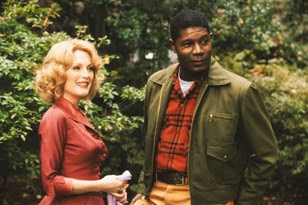
I admired Todd Haynes's 2002 film Far From Heaven, but I did not love it. Perhaps I do not know the Douglas Sirk films that he is so astutely paying homage to, but I know the type. He seeks to rip the facade off of the perfect life of the 1950's and examine sexuality, power, agency and conformity. His artistry is admirable, and Haynes has proven himself to be a master at modulating costumes and colors. Julianne Moore looks like the quintessential mother figure from any movie or television show of the era that I have seen. She plays Cathy Whitaker, the perfect mother and wife, whose life quickly begins to disintegrate around her. Within the context of the story, Cathy is trapped. Her husband Frank (Dennis Quaid) feels compelled to have a double-life and get away with it, and inside of her large home with her two children, Cathy feels heartbreakingly alone. Her growing connection with her African-American gardener Raymond Deagan (Dennis Haysbert) has a light but transgressive quality that sends waves across their idyllic Connecticut community. The more I thought about Far From Heaven, the more I thought about Ibsen's A Doll's House with its images of imprisonment and desire for female empowerment. Haynes throws conflict at these characters, but his story moves within the limitations of the time period. A climactic moment must just be that: a moment of recognition and possibility, but within the world of these characters, nothing more can be. I found the ending somewhat frustrating, but perhaps that is Haynes's point. Cathy Whitaker found herself constrained on all sides within her marriage, her social status, and her community. To break free may be what a modern audience expects.

The cast is excellent, and Moore delivers a strong performance of great interiority amidst the posturing and conventions that must be upheld as a housewife of this time period. Her best moments come when her character finds herself face-to-face with uncertainty. Quaid and Haysbert do fine work as well, and the film has a stagy quality with its small but focused cast. The bright colors of the transforming leaves hint at Haynes's message that transformation for this society is coming soon; the seasons are a changing, but the change does not come quick enough, and there are many hurt and excluded and powerless in this type of society. We see Cathy nudging ahead, uncertainly pushing forward on beliefs about race and gender that will eventually sow the seeds of the Civil Rights and Gay Rights movements to come. One cannot help but wonder what happens to her after that final shot. Todd Haynes remains a director with an eye for composing a shot, handling color and light with ease, and Far From Heaven, though perhaps less powerful for me because of my ignorance of its references and genre, has a well-crafted and thoughtful atmosphere.

Wednesday, June 11, 2014

The Fluidity of Bob Dylan: Todd Haynes' exciting I'm Not There.


Movie Review: I'm Not There

Director: Todd Haynes

Reviewed: 8 June 2014

jamesintexas rating-- ***1/2


Identity is not a fixed state. In addition to our lives being a series of transformations, subtle or otherwise, into different versions of ourselves, the times and scenes that we live in exist in a state of flux: fashion, politics, pop culture, and language to name a few. Life as a series of poses. Life as a constant shedding of skin. The person that I was at 25 is different than the person that I am at 35 despite a longing to be consistent. Early in I'm Not There, a thrilling riff on the idea of a biopic of Bob Dylan, his fans gasp and guffaw at the infamous plugging-in-Dylan-goes-electric moment at the Newport Folk Festival (dramatized by stylish director Todd Haynes as a violent shooting of weapons directly into the audience). Haynes positions the fans in a long horizontal line, walking away from the concert, and he tracks each person's face briefly for a direct camera aside, all critical of the performer's new style. "He's changed," laments one fan at Dylan's latest transformation from beloved folk musician into something new. "He's changed."

Besides being the cliche line of every film ever wanting to convey a character's descent, decay, or fall from his or her core values, "He's changed" as a fan's assessment of a beloved artist encapsulates a stifling of creative artistic desire, a need to pin down with a predictable, comforting label. "He's changed" denies the eternal mutability of an artist, and instead insists that nothing change. You are what you are. One is what one is. Elasticity is to be feared and reviled. Todd Haynes crafts his entire multidimensional, elliptical film around epochs in Bob Dylan's life, dramatizing each with a different performer playing him: Marcus Carl Franklin as Woody, a young African-American boy hopping box cars and playing the guitar in the late 1950's; Ben Whishaw as Arthur, the poet under interrogation from authorities; Christian Bale as the earnest performer Jack who later becomes a Christian pastor; Heath Ledger as Robbie, the movie star version of Jack and his messy love affairs; Richard Gere as Billy, the loner outlaw on the run in a mythical western town; and Cate Blanchett as Jude Quinn, the 1965 goes-electric version, all black sunglasses and wild hair, beset on all sides by interviewers and disgruntled fans. Besides being an audacious move to show so many lenses through which to view the performer, Haynes delivers modern looks at each of the musician's songs in the film, layering them in with modern day performers providing the singing voices in complement to Dylan's actual voice.

Instead of finding the secret or key of Bob Dylan in this movie, the title suggests an elusiveness and an impossibility of such a task. Of all the stories, Jude's resonates the strongest because of Blanchett's inimicable posture with the British press, the stark beauty of the black and white cinematography, the sense of whimsy in depicting Dylan encountering The Beatles and Allen Ginsberg. Other sequences have an even more lyrical and dreamlike quality such as Billy's wandering through the small town with its sad clowns, Civil War iconography, circus performers, and even a giraffe. Woody's rambling days are shot with impossibly gorgeous color, yellows of forests and leaves that nearly explode off of the screen. And the chapter of Robbie's love affair with Claire (Charlotte Gainsbourg) devastates with its forlorn gestures of beauty, its loving distance, and the sequences are impossibly elegiac with all the promise of Ledger

As a fan of any band or musician knows, the shifting of genre or time often seems to divide us into warring camps. I started to listen to my favorite band R.E.M. with some radio singles from Green in the early nineties before buying my first album Out of Time. The R.E.M. before that seems more mysterious to me since I dove into their music at a different point in their artistry. An earlier fan may lament the state of the songwriting that I worship. But it is the same band. Or not at all. And the artists that we love sometimes produce art that we cannot stand or make changes that we hate. I'm Not There posits the absolute necessity of Bob Dylan's shapeshifting not merely as a reaction to the press and popularity and pressures. Instead it becomes a Whitmanesque anthem, a Twentieth Century "Song of Myself" wherein the artist contains and is allowed to contain multitudes. Outlaw Billy puts it best: "I can change during the course of a day. I wake and I'm one person, when I go to sleep I know for certain I'm somebody else. I don't know who I am most of the time." Exciting in its sense of possibility, Haynes has created a stunning and audacious film, one that challenges notions of American identity through the impossibly dramatic and captivating personas of Bob Dylan. The film's reach reminds me of Cloud Atlas in its insistence on the fluidity of identity, but in general, it is an extraordinarily unique vision. I highly recommend it.